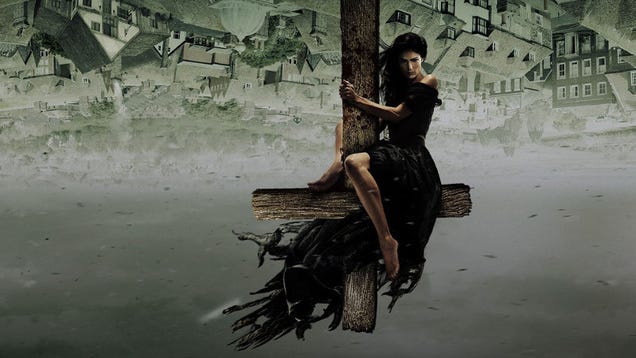
The real world mystery of CRIMSON PEAK's myriad failures is far more perplexing and disturbing to me than the fictional mystery at the heart of the film. Perhaps doubly so because I have long admired Guillermo del Toro both as a director and as an ambassador for high quality genre film-making. The man is one of the best "movie" directors working today, with many near-perfect popcorn flicks under his belt, and he's given the world at least one bona fide cinematic masterpiece in Pan's Labyrinth. So what the hell happened with Crimson Peak?
First and foremost, it isn't very scary. The ghosts are essentially just souped up versions of the overly-CGI titular specter from the 2013 horror hit Mama, which was also produced by del Toro, and which also featured Jessica Chastain in a leading role. Of course, in interviews, del Toro claims that he never set out to make a horror movie, but a "Gothic" romance, in the formal sense of the word. But invoking a word was never going to keep this film's audience from feeling misled, especially after Crimson Peak's marketing campaign tried to position it as "the ultimate haunted house movie", complete with a Halloween-friendly release date and a ringing endorsement from Stephen freakin' King.
Adding more sting to Crimson Peak's failure is the fact that, despite the above-mentioned expectational handicap, it actually starts out pretty strong. In bringing the people and places of late 19th century Buffalo to life on the big screen, one authentic detail at a time, del Toro succeeds in conjuring up some legit movie magic. He gives his actors a very real, believable universe to inhabit, and they repay the favor by delivering organic, easy-to-root-for performances. Mia Wasikowska, Tom Hidleston and the aforementioned Chastain are more than adequate as the central, incestuous love triangle (Gothic indeed!), while Burn Gorman and Jim Beaver provide stand-out performances in supporting roles.
So when and where does the whole enterprise go pear-shaped? I've got it pinned down to a single scene, which features one of the worst shaving "accidents" ever captured on screen. After that, when the setting jumps overseas to England's bleak and blustery North Country, it's almost as if del Toro lets everything drop so he can spend all his time concentrating on his most obvious priority: Crimson Peak, itself. He spends so much time exploring every nook and cranny of that isolated, dilapidated and, admittedly, gorgeously-rendered manor house that he hardly has time for such petty annoyances as characters, plot, or anything else. The film descends into a series of silly, predictable, occasionally bloody but ultimately uninvolving set pieces, and the whole thing ends with a decidedly muted whimper, almost as though del Toro and crew knew that they had a lemon in the can.
It's fucking depressing, is what it is.
Because I'm still a fan of del Toro's work, I feel compelled to point out that even though it was a box office failure, Crimson Peak does have its defenders. Unfortunately, to this fan's way of seeing things, it is an occasionally interesting, somewhat noble, but ultimately failed, experiment.
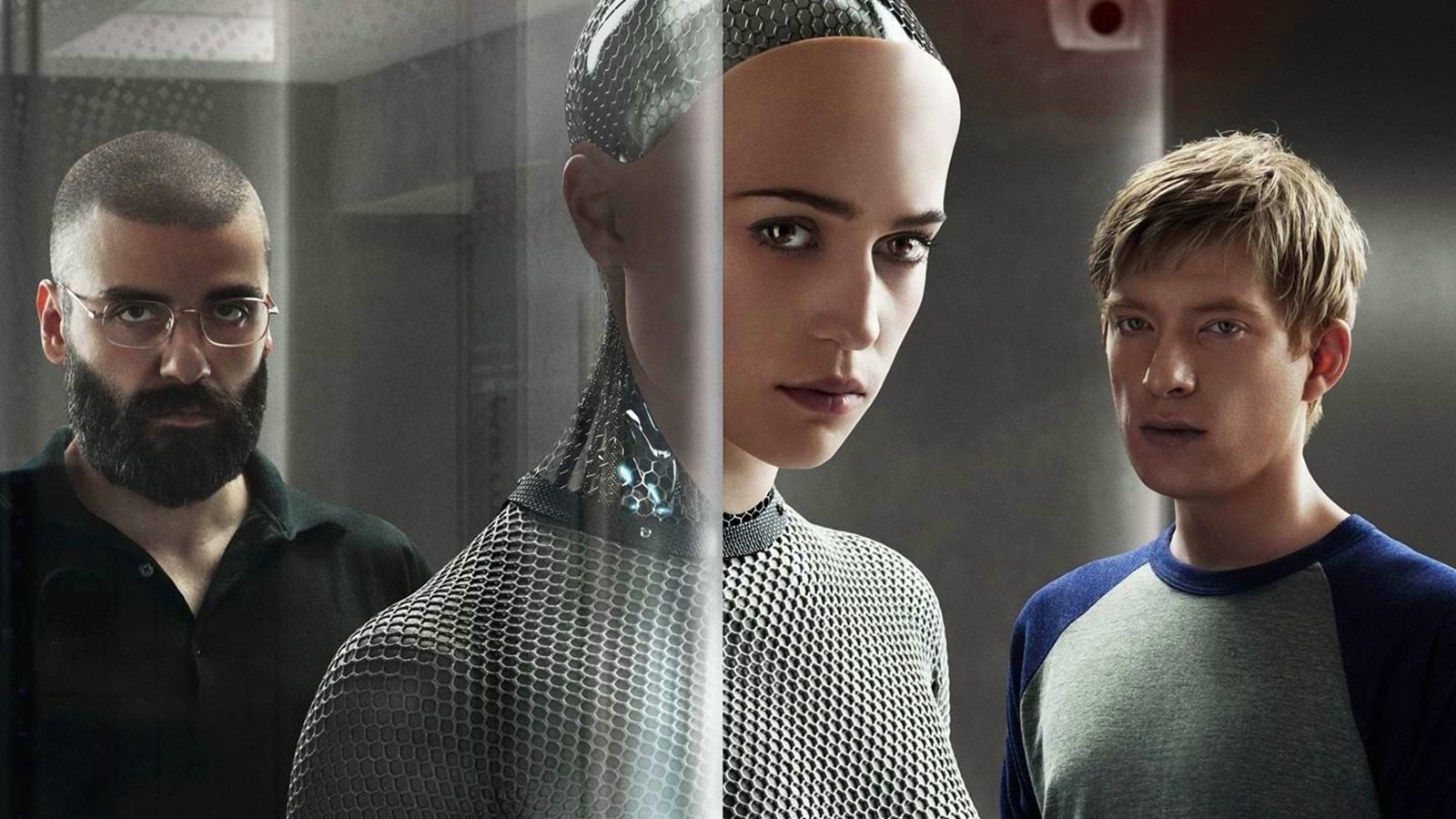
Late last year I started watching EX MACHINA, starring current Star Wars Universe newbies Oscar Isaac and Domhnall Gleeson as a reclusive billionaire genius inventor and his amanuensis/guinea pig, whom he flies out to a ridiculously opulent Alaskan compound to serve as a human Turing Test for his latest invention: Eva, a beautiful synthetic humanoid AI portrayed by Swedish ballerina Alicia Vikander. After about 15 minutes, I got the sense that this was a low-budget take on the "Singularitysploitation" film genre that has given us the moribund likes of Transcendence and Lucy, so I gave up on it.
This week I finally got around to watching the whole thing, and I'm very glad that I gave it a second chance. Ex Machina is a strong film in pretty much all respects, and it works on many levels. It is, for instance, a great twist on the Frankenstein story. It also works as a high-tech corporate thriller of sorts, but that doesn't prevent first-time director Alex Garland from weighing in on some pretty heavy contemporary philosophical issues as well, even though his film isn't as subtle or explorative as, say, Spike Jonze's somewhat similarly-themed 2013 masterpiece, Her.
Performance-wise, Oscar Isaac delivers the star turn here as Nathan Bateman, a preening, egotistical, hyper-dominant alpha whose behavior towards his employees (and creations) pivots from buddy-buddy to borderline psychopathic with disorienting speed. It is in these moments and others that Ex Machina veers into horror movie territory, a tonal shift accentuated by an impressive and very effective musical score.
In this cinematic era of dumbed-down superhero sequels and endless retcon reboots, it is a rare thing indeed for a sci-fi movie to exhibit any kind of genuine intellectual curiosity, or demand a certain level of intellectual sophistication from its audience. That Ex Machina manages to do so while also being an unapologetic entertainment is, in and of itself, a great success.
With projects like Ex Machina, Her, and the British TV series Black Mirror breaking bold new ground and expanding what is considered possible to portray in the realm of popular speculative fiction, perhaps the "Singularitysploitation Curse" has, at long last, been broken. One can only hope.

There seems to be a running theme in today's movies. Crimson Peak is about a massive, ancient, decaying English manor house that seems to have a life of its own. Ex Machina is set in a sprawling, isolated compound in the middle of the Alaskan wilderness; a cross between a penthouse apartment and the Overlook hotel. And in WE ARE STILL HERE, a grieving couple who have lost their adult son attempt to distract themselves by moving into a hundred-plus-year-old farmhouse that used to be the town funeral home, somewhere in rural New England. Smart move, folks!
The first full-length film to be directed by veteran indie horror writer/producer Ted Geoghegan, We Are Still Here is set in 1979, and was shot to seem as though it was made back then, too. This is a cinematic stunt that Geoghegan-associated director Ti West performed with great success for his 2009 retro-horror slow burn classic, House of the Devil. Genre MVP Barbara Crampton portrays grieving mom Anne Sacchetti, who believes her son Bobby's soul has followed them to their new home, and Andrew Sensenig plays her gently humoring but deeply skeptical husband, Paul (the man with the Biggest Forehead in the World).
Things turn real creepy real fast, as photographs get knocked over, an electrician is brutalized by a half-seen evil presence, and a neighbor (Monte Markham!) stops by to divulge the awful history of the house and its 19th century tenants, the dreaded Dagmar clan. Seems old Lassander, the Dagmar paterfamilias, had taken to burying empty coffins in the graveyard, selling the townsfolk's deceased to nearby universities as practice cadavers, and also to certain unscrupulous restauranteurs in Boston's Chinatown, for use as Chop Suey eat. Needless to say, the whole family was ridden out of town on a rail.
After that, the weirdness escalates quickly, prompting Anne to call in her wacky, New Age friends, May and Jacob Lewis, played by Lisa Marie and Larry Fessenden (an indie horror institution and the man with the Second Biggest Forehead in the World), for moral and spiritual support. She also invites May and Jacob's son, Harry, who was Bobby's college roommate, to tag along with his girlfriend. Unfortunately, the mayhem escalates so quickly and with such brutal, bloody violence that many of the characters never even get a chance to lay eyes on each other.
Nostalgic and yet somehow, paradoxically, fresh and original; polished and professional, yet with an endearingly hand-crafted aesthetic; occasionally chuckle-inducing, yet with moments of brutal savagery and blood-freezing horror. As I watched, enthralled, I noted echoes of classic John Carpenter, Lucio Fulci, early Cronenberg and the amazing, sui generis masterpiece Phantasm (1979). Fans of classic horror cinema, you owe it to yourselves to seek out and watch this film at your earliest possible convenience.
[This article was edited on the evening of Thursday, January 7, 2016, to correct certain mistakes as pointed out by my writing partner and best buddy, Marc Roussel. Thanks, Marc! - YOPJ]