Showing posts with label suggested reading list. Show all posts

Friday, October 18, 2019

SUGGESTED READINGS AND VIEWINGS ~ FRIDAY, OCT 18


The above comic, which presents the "arguments" of Alex Jones' fascism-adjacent sub-moronic lackey PeeJay Watson pretty much verbatim, is by Matt Bors. He's pretty great. Check out more of his work at his website.

***

I COULDN'T HELP BUT NOTICE...

It's odd, isn't it?

Lie on a document to get your kid into a better school in a neighboring district, and you might end up getting arrested and cooling your heels in the hoosegow... especially if you're Black! 

Spend megabucks in an effort to bend the rules, or sweeten your spawn's CV in an attempt to score them a coveted spot at an Ivy League university, and you, too, might go to jail. Even if you're a celebrity!

But if you create a fraudulent "university" that bilks thousands of people out of millions of dollars in exchange for a big hairy box of Sweet Fuck All, except for the opportunity to be upsold even more worthless "programs" based not on their value, but on how much money you have in your bank accounts, or can get via various forms of credit... and you can become President of the United States of America. 

That's how sick, twisted, and generally fucked up things are these days. And it's got nothing at all to do with gay folks, or atheists, or the lack of guns in schools, or whatever stupid fucking bullshit it is that right-wingers believe might help to make things better.

Oh, hey, to all my Canadian friends and family... this Monday, you better get out and VOTE! And you better vote for the Liberal Party if you know what's good for ya! 

Heheh... I kid, I kid. But seriously... vote Liberal. Because independent auditors have proven that, when it comes to keeping election promises, Trudeau's record is actually pretty goddamn good.

Tuesday, September 10, 2019

SUGGESTED READINGS


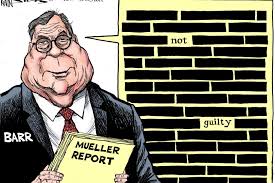
In late June, TIME Magazine published a very succinct and useful report by distinguished legal scholars Barbara McQuade and Joyce White Vance, outlining Eleven Mueller Report Myths that Won't Go Away. I present for you here, first, their brief introduction, followed by the first-listed myth, and the authors' explanation as to why, exactly, it's so bogus:
When we joined other legal experts earlier this month to testify before the House Judiciary Committee regarding lessons from special counsel Robert Mueller’s investigation, it became apparent from the questioning that a number of misconceptions continue to exist regarding Mueller’s findings. The narrative was shaped by Attorney General William Barr, who issued his description of Mueller’s conclusions three weeks before the public saw the full 448-page report. In a letter to Barr, Mueller complained that Barr’s summary “did not fully capture the context, nature and substance” of his team’s work and conclusions, and created “public confusion.” Here is our effort to dispel some of those myths.
Myth: Mueller found “no collusion.”
Response: Mueller spent almost 200 pages describing “numerous links between the Russian government and the Trump Campaign.” He found that “a Russian entity carried out a social media campaign that favored presidential candidate Donald J. Trump and disparaged presidential candidate Hillary Clinton.” He also found that “a Russian intelligence service conducted computer-intrusion operations” against the Clinton campaign and then released stolen documents.
While Mueller was unable to establish a conspiracy between members of the Trump campaign and the Russians involved in this activity, he made it clear that “[a] statement that the investigation did not establish particular facts does not mean there was no evidence of those facts.” In fact, Mueller also wrote that the “investigation established that the Russian government perceived it would benefit from a Trump presidency and worked to secure that outcome, and that the Campaign expected it would benefit electorally from information stolen and released through Russian efforts.” 
To find conspiracy, a prosecutor must establish beyond a reasonable doubt the elements of the crime: an agreement between at least two people, to commit a criminal offense and an overt act in furtherance of that agreement. One of the underlying criminal offenses that Mueller reviewed for conspiracy was campaign-finance violations. Mueller found that Trump campaign members Donald Trump Jr., Paul Manafort and Jared Kushner met with Russian nationals in Trump Tower in New York June 2016 for the purpose of receiving disparaging information about Clinton as part of “Russia and its government’s support for Mr. Trump,” according to an email message arranging the meeting. This meeting did not amount to a criminal offense, in part, because Mueller was unable to establish “willfulness,” that is, that the participants knew that their conduct was illegal.
Mueller was also unable to conclude that the information was a “thing of value” that exceeded $25,000, the requirement for campaign finance to be a felony, as opposed to a civil violation of law. But the fact that the conduct did not technically amount to conspiracy does not mean that it was acceptable. Trump campaign members welcomed foreign influence into our election and then compromised themselves with the Russian government by covering it up. 
Mueller found other contacts with Russia, such as the sharing of polling data about Midwestern states where Trump later won upset victories, conversations with the Russian ambassador to influence Russia’s response to sanctions imposed by the U.S. government in response to election interference, and communications with Wikileaks after it had received emails stolen by Russia. While none of these acts amounted to the crime of conspiracy, all could be described as “collusion.”
Pretty thorough, not to mention disturbing, stuff. There's also great, revealing material on the flawed logic behind all the various Trumpnik preemptive defense strategies, like the "double jeopardy" gambit, all the way down to the Nixonian "it's not illegal if the President does it" argument. Anyhoo, it's well worth reading. Of, if you're lazy, at LEAST watch this video about the same topic.


***

In a world where the President of the United States of America is capable of tweeting out the above "disinfographic" to his millions upon millions of Social Media followers, despite the information contained therein being totally false, created pretty much exclusively to get "white" people to fear and hate Black people even more than they've already been conditioned to over the last few hundred years, it's a damn good thing there exist organizations like the Southern Poverty Law Center (increasingly despised and lied about by the Far Right, the Alt-Right, and now, increasingly, "mainstream" conservatives) fighting the good fight and setting the record straight with contributions like their excellent report, entitled "The Biggest Lie in the White Supremacist Propaganda Playbook: Unravelling the Truth About Black on White Crime". The Executive Summary declares, in part:
The idea that black people are wantonly attacking white people in some sort of quiet race war is an untruthful and damaging narrative with a very long history in America.  
On a Wednesday night in June 2015, a 21-year-old white man walked into a black church in Charleston, South Carolina, and gunned down nine black parishioners taking part in a weekly Bible study group. Dylann Storm Roof sat quietly with the group for about an hour before taking out his Glock pistol and firing 70 rounds, stopping five times to reload. Court testimony revealed that during the shooting Roof said, “Y’all are raping our white women. Y’all are taking over the world.” 
How this horrific violence came to take place traces back to a particularly destructive idea, one as old as the United States itself and rooted in the country’s white supremacy: that black men are a physical threat to white people. The narrative that black men are inherently violent and prone to rape white women, as Roof said during his rampage, has been prevalent for centuries. This idea has served as the primary justification for the need to oppress black people to protect the common — meaning white — good. 
Roof saw himself as a victim standing up for oppressed whites, not as an aggressor. He had a racist “awakening” spurred by online research he did about the 2012 murder of the black high-school student Trayvon Martin. As he wrote in his manifesto, the Martin killing “prompted me to type in the words ‘black on white crime’ into Google, and I have never been the same since that day.” 
Roof’s internet search quickly led him to the website of the white supremacist Council of Conservative Citizens, a group that claims to document an ignored war against whites being waged by violent black people. Google led Roof down a rabbit hole of hate, leaping from one hate site to the next, many filled with “evidence” that black people are pillaging, raping and murdering white people. 
“There were pages and pages of these brutal black on White murders,” Roof wrote in his manifesto. “I was in disbelief. At this moment I realized that something was very wrong. How could the news be blowing up the Trayvon Martin case while hundreds of these black on White murders got ignored.” 
It’s not surprising that a fragile-minded young man who swallowed hate material whole came to see this so-called problem of black-on-white crime as something he had to personally confront. But the resonance of these ideas goes much deeper, infecting the thinking of many prominent people, including public policymakers to this day.
Take then-Presidential Candidate Donald Trump, who in November 2015 tweeted an image that originated from a neo-Nazi account that made exactly the same point as the hate sites Roof was reading. Filled with bogus crime statistics, the graphic Trump tweeted supposedly showed that black people are uniquely violent. The Washington Post found that the data in Trump’s tweet to be false.  
One of the most exaggerated statistics was about the number of white people killed by other white people. Trump’s tweet claimed the number was 16 percent, while the FBI’s data shows it is 82 percent. The tweet also asserted that 81 percent of whites are killed by black people; the FBI number is 15 percent. As the Post concluded, “Trump cast blacks as the primary killers of whites, but the exact opposite is true. By overwhelming percentages, whites tend to kill other whites. Similarly, blacks tend to kill other blacks. These trends have been observed for decades.” 
It’s not just Trump. The far-right ecosystem repeats versions of these ideas ad nauseum. Relying on “statistics” found in a white supremacist tract, the paleoconservative one-time presidential candidate Pat Buchanan wrote in 2007: “The real repository of racism in America — manifest in violent interracial assault, rape and murder — is to be found not in the white community, but the African-American community.” Until very recently, Breitbart news used a “black crime” story tag. 
Misrepresented crime statistics are a main propaganda point of America’s hate movement, and a pillar of white supremacist thinking in the United States. Stormfront, the oldest hate site on the internet, has thousands of pages devoted to the “issue” of black-on-white crime. 
The idea that black people are wantonly attacking white people in some sort of quiet race war is an untruthful and damaging narrative with a very long history in America. White Americans’ unsubstantiated views about the potential of violence from black people was the number one excuse they used to justify slavery, lynching, Jim Crow and various forms of mass incarceration. Never was Klan violence or the lynching of black people by white people ascribed to an inherent white trait. Without the ability to claim oppression of black people as a form of self-defense, racial segregation and white supremacy would be seen for what they are: rank oppression of other people for financial or other benefit. 
The maze of online white supremacist propaganda that Roof entered into is largely no more. Google cleaned up its search results after the Southern Poverty Law Center publicly exposed the problem in a January 2017 video. When black on white crime is typed into a Google search now, the results return legitimate sources of information, such as the FBI’s crime statistics, mainstream news and academic research.
Okay, so I know that's a LOT of information to absorb. But give me a break... it's a big fuckin' topic. That's why you should probably download the full report and read it at your leisure. I mean, just in case you missed the court case that basically removed all doubt about how conservatives/right-wingers/Republicans are pretty much all racist sacks of shit, if and when they think they might be able to get away with it, check out the linked to a Washington Post article by Christopher Ingraham.

***

And, finally for today, the Los Angeles Review of Books has published Tony Fonseca's magnificent career overview of Ramsey Campbell, one of yer old pal Jerky's all-time favorite writers in any genre, who just happens to be an absolute master of the Modern English horror story. After starting off on the wrong foot with a terrible title--"Horror For People Who Don't Like Horror"?! NON-sense!--it quickly gets down to business, starting out with a thorough accounting of Campbell's early ouput:
RAMSEY CAMPBELL IS ONE of the most respected authors of weird and dark fiction in the world. Born in 1946, he began reading Lovecraft at the age of eight and began writing when only 11. As a teen, he submitted Ghostly Tales, a self-illustrated collection of 16 stories and a poem, to a reputable publisher, under the name John R. Campbell. Although the stories were rejected because of their genre, the publisher encouraged Campbell to keep writing (the author’s juvenilia was eventually published in 1987, as a special issue of Crypt of Cthulhu magazine). In 1961, Campbell submitted a story to Arkham House’s iconic author/publisher August Derleth. That story, “The Church in High Street,” appeared in the anthology Dark Mind, Dark Heart (1962), edited by Derleth, under the pseudonym J. Ramsey Campbell. It was Campbell’s first professional publication. 
Campbell’s first published book was the Lovecraft-tinged The Inhabitant of the Lake and Less Welcome Tenants (1964), published by Arkham House when he was 18. His collection Demons by Daylight (1973) brought attention to his distinctive style and thematic concerns, and eventually led to a second Arkham House collection, The Height of the Scream (1976). That same year, he published his first novel, The Doll Who Ate His Mother. His second novel, The Face that Must Die (1979), explored dark psychological themes of madness and alienation — themes he would return to throughout his career. He received his first World Fantasy Award in 1978 for the story “The Chimney,” his second in 1980 for “Mackintosh Willy.” His 1980s novels and novellas — The Parasite (1980), The Nameless (1981), Incarnate (1983), The Claw (1983), Obsession (1985), The Hungry Moon (1986), The Influence (1988), Ancient Images (1989), Midnight Sun (1990), and the semi-comic Needing Ghosts (1990) — displayed a newfound interest in switching between the horror, dark fantasy, thriller, and crime genres. 
Campbell hit his stride in the 1990s, publishing his first dark comedy, The Count of Eleven (1991), followed by The Long Lost (1993) and the three novels Campbell fans line up behind when they want to argue for his mastery: The One Safe Place (1995), The House on Nazareth Hill (1996), and The Last Voice They Hear (1998). Campbell has remained prolific, his more recent output including Silent Children (2000), Pact of the Fathers (2001), The Darkest Part of the Woods (2003), Secret Stories (2005), The Grin of the Dark (2007), Thieving Fear (2008), Creatures of the Pool (2009), The Seven Days of Cain (2010), Ghosts Know (2011), The Kind Folk (2012), Think Yourself Lucky (2014), and Thirteen Days by Sunset Beach (2015). Never one to rest on his laurels, he has recently (and incredibly quickly) completed his Three Births of Daoloth trilogy: The Searching Dead (2016), Born to the Dark (2017), and The Way of the Worm (2018). Word has it that yet another novel, The Wise Friend, is due to be published in autumn 2019. 
One of Campbell’s earliest creations was the fictional city of Brichester (of the fictional Severn Valley), around which he constructed an elaborate mythos. He recently returned to the Brichester Mythos in the novella The Last Revelation of Gla’aki (2013). The Three Births of Daoloth trilogy (a.k.a. The Brichester Trilogy, all three titles released by PS Publishing) further develops the cosmic horrors he invented as a young man in The Inhabitant of the Lake. In a 2016 interview with psychology professor and horror author Gary Fry, Campbell explained his motivation for the trilogy: he wanted not only to update the Brichester mythos but also to perfect it, correcting the small mistakes he had made as a young writer. He conceived of the trilogy as a unit, so the series is tightly knit and the vision consistent, even as the story and characters evolve over 60 years. The trilogy is a nod to some of Campbell’s other early influences, such as Arthur Machen, but it was Lovecraft, according to Campbell, who provided the “crucial focus.” In the trilogy, Campbell aims for cosmic terror, calling it “the highest aspiration of the field” because it results in “a sense of awe that can border on the numinous, or more precisely a dark version of that experience.”
Look, I'll probably have more to say about Campbell at some later date, but for now, I'm falling asleep at the computer due to recent bouts of insomnia. In the meantime, you should definitely check out his work, as it is goddamn magnificent. I'm a particular fan of his short works. The anthologies Cold Print (for his Lovecraft-influenced early work), Demons by Daylight, and Dark Companions are all great places to start!

Sunday, July 21, 2019

QUOTE OF THE DAY, SUGGESTED READINGS, AND MORE!


First up, we have this very interesting, in-depth exploration in the New York Times that sheds some light into how Youtube accidentally (?) became the world's most effective vector for Far Right propaganda, thus radicalizing a generation of young men and boys into reactionary politics. Remember, if you've already reached your quota of free NYTimes articles for the month, just open this article in an "incognito" window.

***

Next up, but definitely related, comes this series of VICE interviews with people who have literally lost family members to the deranged, Trump-centric, post-Pizzagate, conspiranoid hurricane of weaponized nonsense known as "Qanon". It begins:

One of the most disheartening signs of our advancing hellworld are the thousands of people who wholeheartedly believe in the deranged conspiracy known as QAnon. 
It's near impossible to summarize the entire QAnon conspiracy theory, as it’s fluid and ever-changing. The nuts and bolts are that a secret government insider, the titular Q, has taken to the internet forum 8chan of all places to drop clues (known in the community as Q Drops breadcrumbs) about how U.S. President Donald Trump is taking down the deep state. The conspiracy takes some twists and turns into the occult, an ever-present cabal of pedophiles, possible executions, and the idea JFK Jr. may have faked his own death and is cosplaying as an old guy who goes to Trump rallies. 
While the QAnon conspiracy often feels like an elaborate troll, an online community of real, actual people has built up around it. There’s been a lot written about how lonely these people are, how they will cut themselves off from their family ... and poking fun at the whole thing. Rick Ross, a cult deprogrammer and executive director of the nonprofit Cult Education Institute, says the community bears a lot of the hallmarks of a cult: the main character is infallible and everything is part of a greater plan. ...
No one knows how hard it is to break through a bubble one creates around themselves than loved ones. While maybe it’s funny for those outside peering in, what is it like for those who are close to them, the people who experience their loved one's brain being rotted by YouTubers breaking down 8chan posts in real time? 
I decided to seek them out. I found a woman whose husband became so obsessed with YouTube conspiracy videos he would follow her around the house and force her to watch them, someone who avoids their mother because of Q, and someone who was dumped by the man she loved because she actively attempted to debunk QAnon. Here are their stories.
Some of these stories are ridiculous, while some are truly heartbreaking. All of them are disturbing, in that they provide yet more evidence to the increasingly voluminous pile that shows how we are, most likely, up against something that goes far beyond the mere human propensity for occasionally believing stupid things. 

I think it's patently obvious by now that what we are witnessing is an engineered phenomenon, wherein a new generation of propagandists have at their disposal bleeding edge communications tools and predictive psychometric technologies that have allowed them to create "psychiatric software" bordering on literal mind control. 

This is one of the core elements of my "New Fascist International(e)" theory, which I hope to explain more fully in an ebook that I've been working on for the past two and a half years. So keep your eyes peeled.

***

In an important op-ed piece for the Washington Post, Paul Waldman describes the lengths to which a newly empowered Far Right are going in order to prevent those who have yet to be brainwashed into their cult from voting at all, thus maintaining their illegitimate grip on power until the day finally comes when they can do away with the charade of democratic elections altogether, and simply exert their God-ordained right to rule over their lessers entirely unimpeded.

Unfortunately, WaPo is behind a paywall nowadays, so if you find yourself locked out, here is a distillation of Waldman's most important points and revelations:

As we turn our attention toward the 2020 elections, Republican lawmakers across the country are asking: How can we keep people from voting? In Tennessee, which already has lower-than-average rates of turnout, the legislature is on the case: 
"Tennessee could penalize some paid voter registration groups with fines for too many faulty signups and criminal charges for violating new requirements under a proposal passed by the House on Monday. The vote bucked some voting rights groups, who have voiced fear that the bill would create a chilling effect on Tennessee’s already-poor voter participation marks. Republican Secretary of State Tre Hargett has made the legislation a top priority, deeming it important for election security after Shelby County, which includes Memphis, saw a flood of often-faulty registrations that came in on last year’s deadline. But Tennessee Black Voter Project, which led the voter signup charge in Memphis and elsewhere across the state, has said the bill immediately followed the group’s efforts to register 86,000 black voters."
Under this law, organizations that mount voter registration drives will have to be trained by the state, and then they can be fined and face jail time if they have lots of registrations with mistakes. 
Just to provide a bit of context, every group that does registrations gets some faulty ones. When you sit at a table outside a supermarket registering people to vote, there are always jokesters who will fill out the form in the name of Mickey Mouse or Clark Kent, but the group doing the registering is legally required to submit the forms, even if they’re sure they’re false.

The problem here is obviously not that erroneous registrations create some kind of unmanageable burden on state officials, because they've always existed and always will.
It’s that too many black people registered to vote in Tennessee, and something had to be done about it. 
So in addition to using all the other tools in their voter-suppression drawer, Republicans in Tennessee decided to clamp down on registration, knowing full well that liberal groups are much more likely to mount registration drives than conservative groups.
This isn’t the first time something like this has been tried. Before the 2012 election, Republicans in Florida passed a registration law so restrictive that it led nonpartisan groups such as the League of Women Voters and Rock the Vote to suspend their voter registration drives in the state.

Senate Majority Leader Mitch McConnell (R-Ky.), who often makes plain what other Republicans prefer to conceal amid a fog of misdirection, used to say that “low voter turnout is a sign of a content democracy.” More recently he has described Democratic efforts to make voting easier, with measures like making Election Day a national holiday, as a “power grab.” In other words, he makes no bones about the fact that if we made it easier to vote, too many people would vote for Democrats.

Every Republican understands that; McConnell is just one of the few willing to say it out loud. But the truth is that suppressing votes is absolutely critical to Republican success. They know full well that their ability to compete and win in the American political process is dependent on the countermajoritarian features of our system — the filibuster, the fact that the Senate gives the same representation to the fewer than 600,000 residents of Wyoming as the nearly 40 million in California, the electoral college — nearly every one of which works to the advantage of the GOP.
And as the party grows more dependent on older, wealthier, white voters — who are more likely to be registered and more likely to turn out — Republicans know that the harder registering and voting is, the more likely they are to win. No prospect is more threatening to Republican success than high turnout.

Consider the last three midterm elections. Last year, turnout was 50 percent, and Democrats won huge victories, including taking back the House. In 2014, a “wave” election for Republicans, it was only 37 percent. In 2010, another Republican wave, it was 42 percent. Anything that gets more people to the polls will be good for Democrats and bad for Republicans. 
Which is why the GOP will do everything in its power to keep registration and turnout low — and why making it easier to vote is so important for Democrats. So in the coming days we’re almost certain to see a further separation between red and blue states.
It will look like this: Where Democrats are in charge, they’ll institute automatic voter registration, same-day registration, no-excuse absentee voting, extended early voting, and anything else that will maximize turnout and make voting easy. Where Republicans are in charge they’ll employ voter ID, restricted early voting, polling place closures, and anything else that will drive voting down, particularly among African Americans.
And if all that isn’t enough, Republicans will go after the people registering voters, too.
Get the picture yet, folks? It isn't four relatively progressive Congresswomen representing their communities and their constituencies who pose a threat to America and the American WayTM... it's the entire radicalized Far Right reactionary pseudo-religious cult into which the Republican Party has transformed over the past few decades that is the TRUE "enemy of the people".

***

But don't take my word for it! Here's a former intelligence agent who was part of the team who drafted National Intelligence Estimates for a previous White House (Paul Nailer is a pseudonym) to tell you why "The Biggest Threat to Our Country Today is the Republican Party". He begins, in part:
In case you’re not familiar with the finer points of threat assessment within the national security apparatus, the NIE is the big enchilada: the document seen by presidents and members of congress; an objective, non-political, comprehensive piece of work that categorises and prioritises the threats faced by the United States. 
While I no longer have regular access to the complete set of intelligence reports from which the NIE is drawn, I have access to some, and I am an avid reader of the related publicly available information. I’ve developed my own amateur NIE based on this information, and here’s the organisation at the top of the list: 
The Republican Party. 
Shocking as that may seem – and your level of shock may vary widely depending on how closely you’ve been tracking the actions both center stage and behind the scenes of the rapidly toxifying Grand Ole Party – the real problem with this revelation is that we cannot actually do much about this threat in the classic manner. 
The threat from the right is the first national-level “insider threat” the United States has faced since the Civil War. It is insidious, asymmetric, powerful – and existential. ... Let me say it again: the Republican Party is the biggest threat the United States is facing. And without proper attribution, recognition, and a well-articulated and implemented counter-strategy, it could be terminal. There is no other reasonable conclusion to be drawn from the facts. 
An enemy of the United States might seek to sow discord between ethnic groups, or to wage a disinformation campaign, or to highlight moral inconsistencies that weaken the standing of the United States on the world stage. An enemy of the United States might try and degrade the capacity and public trust within our intelligence apparatus. It might use propaganda and weaponised information. It might seek to engage in fraud or other criminal acts to sway an election in their favour. Does any of that sound familiar? 
The Republican Party has steadily embraced authoritarianism, suspect electoral tactics, and racism more and more over the past few decades. That process has been turbocharged with Trump at the helm of the party. We’re now seeing an explicit embrace of white supremacy. Denial in the face of climate change. Deliberate sowing of discord within the FBI and the CIA. Weakening of the rule of law. Brazen criminality. Removing funding for elections oversight. Blatant human rights abuses at the border. 
The explicit nature of these acts is the point. The Republicans mean to bludgeon any and all resistance to their reshaping of the nation’s institutions to their will. And so far, they’ve gotten away with it.
I realize that I've quoted from the article quite extensively, and that you may feel like there's no real reason to go ahead and read the entire thing for yourself. But I suggest that you do, if only to more fully grasp the fact that "Donald Trump and his coterie of criminals have done more in two years to weaken the United States than the Soviet Union was able to achieve in decades."


***
QUOTE OF THE DAY!

“But how do we know for sure that the guy who was fined for refusing to rent to Black people and called for a ban on Muslims and called Mexicans rapists and called Puerto Ricans lazy and called for the execution of innocent Black teens is a racist? If only there were a clear sign!”

- Our old pal Jeff Tiedrich over at Twitter expresses his frustration 
over how difficult it is to figure out whether or not 
President Rotten Pumkin Face is a racist or not.

Sunday, June 2, 2019

SORRY I'M AWOL... HERE'S SOME GOOD READING

Hey folks!

Sorry for being AWOL recently. I've been somewhat busy with a number of personal projects in various arenas, currently at various levels of completion. I'll tell you more, here in this space, when I have more to tell. 

Also, to be perfectly honest, the political situation here in North America, and pretty much everywhere around the globe, seems beyond the ability of the average person to comprehend, much less influence. It almost feels like we're desperately clutching the fur of some wildly bucking Beast, anxiously waiting to see what long-established institutional norm will be next to be toppled and shattered by its rampage.

Anyhoo, enough of all that. In the last month or so, I came across a number of interesting articles that I wanted to share with y'all, but never got around to. So today, I decided to do that, before too much more time passed and these articles became less relevant. And so, without further ado, here is my Suggested Reading List for today...

***

Here's a deeply depressing New Yorker piece by Adam Gopnik about how the South were the real winners in the Civil War. It begins:
Not so long ago, the Civil War was taken to be this country’s central moral drama. Now we think that the aftermath—the confrontation not of blue and gray but of white and black, and the reimposition of apartheid through terror—is what has left the deepest mark on American history. Instead of arguing about whether the war could have turned out any other way, we argue about whether the postwar could have turned out any other way. Was there ever a fighting chance for full black citizenship, equality before the law, agrarian reform? Or did the combination of hostility and indifference among white Americans make the disaster inevitable? 
Henry Louis Gates, Jr., in his new book, “Stony the Road: Reconstruction, White Supremacy, and the Rise of Jim Crow” (Penguin Press), rightly believes that this argument has special currency in the post-Obama, or mid-Trump, era. He compares the rosy confidence, in 2008, that the essential stain of American racism would fade through the elevation of a black President with the same kind of short-lived hopes found in 1865, when all the suffering of the war seemed sure to end with civil equality. Instead, the appearance of African-American empowerment seemed only to deepen the rage of a white majority. Then it brought forward Klan terrorism and Jim Crow in the South; now it has brought to power the most overtly racist President since Woodrow Wilson, openly catering to a white revanchist base. It’s a depressing prospect, and Gates is properly depressed and depressing about it.
If you follow this link, you can actually listen to a mellifluously intoned audio version of this article instead of just reading it.

***


Dan O'Sullivan, writing at his ongoing creative project "Welcome to Sullyville", offers up a wide-ranging and substantial meditation on the current state of American culture, particularly as it pertains to how America's creeping Fascism has metastasized into a now exploding Fascism, the hows of it, the whys of it, etc. It's called Pigs, A Million Different Ones, and after a brief introduction, he posits that...
...the Internet is now the world’s largest subduction zone, where an endless column of young, mostly white males are overtaken and crushed by the unstoppable force of far-right extremism. Violent misogyny, Islamophobia, anti-Semitism, gay-bashing, anti-black racism - you name it, you can find it, in ever more plentiful amounts online. 
The biggest tech platforms you can name - Facebook, Google, YouTube, Twitter, Reddit - serve up this kind of poison on an industrial scale, mushrooming and expanding at a rate that makes catching up with the spread almost impossible. The early neo-Nazi webforum Stormfront is on life support, largely because there is no need for the far-right to stay in an online cul-de-sac; they have free run of the world now. Worst of all, those consuming this economy of hate, which has exploded into an epidemic over the past ten years, are still mostly boys. 
Meaning, we as a society are going to be living with the effects of this radicalization for the rest of our lives.
I urge you to read the article in full, and to share it with friends and family... as long as you think they'll get something out of it. O'Sullivan has a pretty good grasp on many elements of the New Fascist International(e) gestalt, and he could be a writer to watch.

***

Our old pal Peter Bebergal, author of Season of the Witch: How the Occult Saved Rock and Roll (my concordance here), has written a lovely article for The Paris Review about a topic that is near and dear to yer old pal Jerky's heart. Titled "To Believe or Not To Believe: That is NOT the Question", it is an exploration of the surprisingly vigorous paradoxical interplay between legitimate, profound skepticism on the one hand, and Western esoteric traditions of occult practice on the other. Along with Eugene Thacker (whose In The Dust of This Planet I also put together a concordance), I think Bebergal is one of the contemporary English-speaking world's finest writers on these topics, and this brief article is a good place to start getting a handle on where it is, exactly, that he's coming from. It begins:
Many years ago at a dinner party, I met a couple who had brought along their two-year-old son. The mother was Jewish, and the father was a practicing Buddhist from Tibet. Making small talk in the kitchen, the mother began to tell me about how she had been unable to get pregnant, so her husband had gone to their lama to ask him to bless them with a child. Some months later the couple successfully conceived, but before they broke the news to friends and family, they received a call from the lama, who told them that their unborn son was a bodhisattva—a being who has achieved enlightenment but chooses to reincarnate for the good of the world. As she told me this story, I felt dizzy and entranced. All I could see was her suddenly illuminated face; all I could hear was her voice. 
Now, I am not a Buddhist, but I experienced what she said about her child as true. He was beautiful and played quietly on the floor at our feet. For me, this was an encounter with the numinous, a realization of holiness and magic that didn’t require what religious people call faith. Moreover, when my trance broke and the other voices and sounds of the party returned to my awareness, I didn’t immediately begin to rationalize what I had been told or how I had felt about it. That spirits of the dead might move through the heavenly spheres and reemerge in new earthly forms seemed as real to me as the food that was being prepared for us. The language the family used to convey the story stirred all our imaginations. 
As a writer whose chosen subject is religion and, more recently, magic and its supernatural cousins, I admit that I am more disposed to exploring, and perhaps even experiencing, these kinds of altered states, but I am not more susceptible to believe in them. Not only because I am often critically challenged by readers and friends but because I am interested in what it means to hold to the irrational with a rational embrace, using skepticism as a compass to travel the map of the weird. One consequence of this, however, is finding myself without a home.
Let me tell you, if the above intro isn't enough to catch your interest and make you want to read the rest of the article, I don't know what to say to you!

***

In the wake of far-right evangelical Jair Bolsonaro being elected President of Brazil, Buzzfeed's Ryan Broderick filed a report arguing that the era of being surprised at this kind of politics is over. Now it's time for us to figure out how to live with what we've done. And what is it, that we've done? Well, that's what his report, entitled How We Radicalized the World, aims to answer, in part. It begins:
From the balcony of BuzzFeed’s São Paulo office right now, you can hear screams of “Ele Não” echoing through the city’s winding avenues. It’s the same phrase I’ve seen graffitied all over the city this month. The same one I heard chanted from restaurants and bars all afternoon. It means “not him” — him being Bolsonaro. But his victory tonight isn’t a surprise. He’s just one more product of the strange new forces that dictate the very fabric of our lives. 
It’s been a decade since I first felt like something was changing about the way we interact with the internet. In 2010, as a young news intern for a now-defunct website called the Awl, one of the first pieces I ever pitched was an explainer about why 4chan trolls were trying to take the also now-defunct website Gawker off the internet via a distributed denial of service (DDOS) attack. It was a world I knew. I was a 19-year-old who spent most of my time doing what we now recognize as “shitposting.” It was the beginning of an era where our old ideas about information, privacy, politics, and culture were beginning to warp. 
I’ve followed that dark evolution of internet culture ever since. I’ve had the privilege — or deeply strange curse — to chase the growth of global political warfare around the world. In the last four years, I’ve been to 22 countries, six continents, and been on the ground for close to a dozen referendums and elections. I was in London for UK’s nervous breakdown over Brexit, in Barcelona for Catalonia’s failed attempts at a secession from Spain, in Sweden as neo-Nazis tried to march on the country’s largest book fair. And now, I’m in Brazil. But this era of being surprised at what the internet can and will do to us is ending. The damage is done. I’m trying to come to terms with the fact that I’ll probably spend the rest of my career covering the consequences.
This is an important piece, and well worth reading if you're trying to wrap your head around what the fuck happened to the world while you were distracted by a variety of shiny new apps and gewgaws. I urge you to read, absorb, and share. I also urge you to check out the comments section, to see how bad the rot has gotten, how severe the Dunning-Kruger-compounded right-wing brainwashing problem has become.

***

Hey guys, just a reminder that I have been putting in a bit of time at my Mediavore blog, having recently begun a media diary of sorts. I call it a reading diary, and I do spend more time on my reading choices than anything else, but I'm also using it to keep track of certain life events (like a recent trip to Landlord/Tenant court) and the movies and TV shows that I watch. So, anyway, if you like that kind of stuff, or if you're at all curious about what the hell the image immediately above this paragraph is all about, then by all means, keep up with my updates over at The Mediavore!

Also, as always, the Useless Eater Blog updates with a new "On This Day" entry, every single day. Enjoy!

Saturday, October 6, 2018

INFO GRAPHICS / SUGGESTED READING

INFO GRAPHICS! CLIP SAVE & SHARE!


For a more complete overview of Wilson's place in the constellation of Far Right activism, and also for more details about his grotesque crimes against a minor, check out this Daily Beast article, which pulls no punches and thus will likely leave you with a terrible taste in your mouth. You have been warned.  


SUGGESTED READING LIST


Okay, I spent a lot of time on the "Info Graphics" sections above and below this "Suggested Readings" section, so I'm going to make this short and sweet. I'm also happy to reveal that I have finished my weeks-long project of cleaning out old stories that I've been wanting to share with y'all since the first months of the year, but for some reason never got around to. I've got one long-ish piece about Jordan Peterson and his misunderstanding of postmodernism left to finish up, polish up and share here, but after that, it's gonna be all new material here at the DDD! 

Unfortunately, that's not so much the case for Kubrick U and The Mediavore, which are both seriously behind schedule, and due for a whirlwind sweep-thru in the coming weeks, themselves. I've also got a couple of job-jobs lined up, so we'll see what happens.  

Anyway, first up, here's a handy-dandy info-sheet containing everything you ever wanted/will need to know about Alabama's Tiny Terror: Jeff Sessions, compiled by those wonderful worker bees over at The Baffler, one of yer old pal Jerky's favorite journals of literary and socio-political goodness!

***
Next up, I know we're all sick to the point of vomiting about what's going down with Brett Kavanaugh, whose performance before the Senate Judiciary committee last week would have been completely disqualifying in a functional democratic republic. But if you've been avoiding that soul-draining debacle (with good reason), maybe you should ingest our old pal Vic Berger's latest video, entitled American Horror Story: A Very Scary Time for Men., just so you at least get the basic gist of how terrifyingly far from the beaten path America has wandered, like a developmentally delayed child chasing a butterfly into a Big Cat sanctuary. 

Here it is:

 
And now, why not round out your Kavanaugh knowledge by reading this Current Affairs article about "How We Know Kavanaugh is Lying", and follow it up with this New York Times editorial that explores one part of Kavanaugh's bizarre, hateful obsession with the Clintons, including helping to spread ridiculous and downright evil Vince Foster conspiracy theories. Turns out there are SOOO many good reasons to despise this sack of crap. I have a feeling he won't be a Supe for very long, regardless of today's vote.

Parting shot re: Kavanaugh: I can't be the only one who thought that, while he was being questioned by Democrats during his confirmation hearings, his constant, pained facial contortions made him look like he was perpetually trapped in the early stages of transforming into a werewolf... right?

INFO GRAPHICS! CLIP SAVE & SHARE!


This big Okie creepshow is pretty much a walking, talking archetype, the living embodiment of Shakespeare's warning about those "who doth protest too much"! Because isn't it almost always the case that the loudest, angriest homophobes among us end up being the most thirsty for the dick? And aren't those who pray loudest always revealed to be the biggest hypocrites by the time the third act rolls around? Anyway, if you really need to know more details about this revolting specimen, here's a good place to start.

Saturday, August 25, 2018

CLEANING HOUSE ~ STORIES I LIKED BUT DIDN'T GET TO SHARE

Okay, so, obviously, what with my reduced output over the past few months (due to many factors, including burnout, lethargy, paying work and a general sense of hopelessness), there have been a number of stories that I'd hoped to share with y'all via my blogs, but haven't. I keep track of these stories on a scratch-pad, where I list general topics and specific reports, op-ed pieces and essays. That scratch-pad has now grown intolerably long, so I'm going to be performing a purge over the next few blog posts here at the DDD, and also at Kubrick U, The Mediavore, and Useless Eater Blog (links available, page right).

Please forgive the lack of organization as we begin with Brian Beutler's op-ed piece for Cracked Magazine, titled The Crime Is Worse Than The Coverup, from which we get the lovely image above, and which begins...
On multiple occasions in 2016, and perhaps stretching back into the previous year, Donald Trump’s presidential campaign fielded solicitations from Russian spies and cutouts offering up stolen Democratic Party emails and other assistance in the election. 
At no point, so far as we know, did anyone working on the campaign report this pattern of behavior to the FBI. After Trump secured the Republican Party nomination, the FBI warned him and his advisers that Russians would try to penetrate their campaign, and asked them to alert law enforcement officials if and when they noticed anything suspicious. They said nothing. Since winning the election, Trump has gone to great lengths to protect Russia from the American intelligence community’s assessment that Russia subverted the election to help Trump and tried to shut down all efforts to determine his level of complicity in that subversion. 
Christopher Steele, by contrast, didn’t hesitate for a second to alert the FBI when, while working for the political intelligence firm Fusion GPS, he unearthed information that convinced him Trump was compromised, susceptible to Russian government blackmail, and conspiring with Russian spies to sabotage Hillary Clinton’s campaign. 
For his trouble, Republicans have tried to run down the former head of the MI6 Russia desk as a partisan operative and a criminal, without whom the FBI’s Trump-Russia investigation would never have taken hold. Despite the fact that he has never testified before Congress, Sens. Chuck Grassley (R-IA) and Lindsey Graham (R-SC) recently accused him of making false statements (presumably, they allege, to law enforcement officials) and referred him to the FBI for investigation.
It only gets better from that point on, containing a great deal of important information and excellent, eye-opening perspective. I urge you to read it and pass it along to any friends that you think could make good use of it. I've got it clipped and saved.

***

Next up, we have this important essay, entitled Yes, Polarization is Asymmetric, and Conservatives Are Worse, from The Atlantic, which hasn't exactly been covering itself in glory in recent months... but more about that later. For now, Norm Ornstein's essay about Pew's monumental new study (based upon over 10,000 in depth field interviews) shows how...
...in the mid- to late-1990s, we did not have anywhere near the level of public polarization or ideological or partisan animosity that we have now. In the public, this phenomenon has been much more recent (and is accelerating). But in the Gingrich era in Congress, starting in 1993, where Republicans united in both houses to oppose major Clinton initiatives and moved vigorously from the start of his presidency to delegitimize him, the era of tribalism started much earlier, while the ante was upped dramatically in the Obama years. The fact is that it was not public divisions on issues that drove elite polarization, but the opposite: Cynical politicians and political consultants in the age of the permanent campaign, bolstered by radio talk-show hosts and cable-news producers and amplified by blogs and social media, did a number on the public.
So, basically, "Bothsiderism" is most likely a result of media whoredom, prizing ratings over truth (and morality), and Republicans are really problematic, on a number of levels. Then of course there's always the issue of conservatives "working the ref", or complaining so constantly and at such high volumes about the "liberal bias" of the mainstream media that said media meekly bends over backwards to appease right-wingers and so as NOT to appear "liberal", which pushes the Overton Window ever further to the right, with the right-wingers never letting up, baying louder and louder at this phantom bias that now has ZILCH to do with reality.

And yet, tragically for the USA, it seems to have been a winning strategy for the worst of all possible elements. I suppose there's not much those of us for whom the above is plainly obvious to do, except to make sure people in our own personal circles understand the tactics being deployed against them, and understand the stakes involved. This article is probably a tick or two above "starter" level, but it's an important one for us seasoned news hounds to read and share with those we believe might benefit from reading it.

***

Seattle's The Stranger has long been one of the premiere big city alternative "free weeklies", and they continue to prove their value with excellent think pieces like Charles Mudede's Mass Shootings Reveal America Is A Civilization That's Reverted To Ritual Sacrifice. It begins:
The complete absence or uselessness of rational action to address the frequency of mass shootings in our society requires that we reexamine them in a completely different light. We cannot continue to see these deaths in the context of a pragmatic, civil debate about gun laws. That will tell us only a little, if anything at all. If you go on Twitter, you will find an endless stream of tweets with links to graphs and research that make it abundantly clear that mass shootings are very preventable. There is no mystery to their cause and persistence. But what if our society is not looking for a solution? What if it's the other way around: It fears the prevention of massacres? These are the kinds of things we now need to seriously consider.

The force that's regularly supplying Americans with bullet-ridden corpses might be much deeper and mostly forgotten, and so cannot be so easily recognized by common sense or the secular left. I propose the context that has greater explanatory power for the persistence of mass shootings in the US is religious superstition. We must stop going on and on about lacking laws that would protect our citizens; we must stop going on and on about how this or that politician has been bought. We are way beyond the point where such considerations are meaningful or productive. We must instead ask: To whom are all of these bodies being sacrificed, and why?
This is not easy reading, and it's bound to spark some intense reactions. But, as with so many of the challenges to which America and the Western World are being subjected, perhaps it requires of us to adopt a new kind of language, so as to more adequately comprehend and address. Where the lexicon of prescriptive social policy falls short, can the advanced linguistic technologies of existential phenomenology carry us closer to an answer? Yer old pal Jerky doesn't know, but he does know that, on a number of fronts, we seem to be running out of options. And as a result, many of us appear to be retreating into the relative safety and comfort of a new dark age.

Which brings us to...

***

...Bradley Babandir's overview of the Silicon Valley tentacle of the New Fascist International, as best exemplified by libertarian/Utopian billionaire vampire Peter Thiel, as revealed in the scathing new tome The Know-It-Alls; The Rise of Silicon Valley as a Political Power House and Social Wrecking Ball, by Noam Cohen (buy via this link so yer old pal Jerky gets a couple shekels in his beggin' cup). Even though it doesn't go quite as far as yer old pal Jerky does in identifying this faction as a de facto, knowing cohort of an incredibly dangerous emerging global conspiracy, it does some important dot-connecting... everything from the extremes of the transhumanistic "imagination", to their vision for a post-democratic technocracy, to their ongoing obsession with certain types of testable/computable/replicable IQ, etc. It begins:
THE PIT OF Peter Thiel’s ghoulishness may be bottomless, but scraping the sides for highlights is worthwhile. The vampiric impulses of Silicon Valley’s libertarian overlord combined with his endorsement of Donald Trump during the 2016 election make him look like a supervillain, but the really terrifying thing about Thiel is the reach of his tentacles and the number of people and companies his money and ideology have influenced. 
Noam Cohen, a former columnist for The New York Times, traces that legacy in The Know-it-Alls, a history of Silicon Valley through the people who shaped it, from John McCarthy, a pioneering midcentury AI researcher, to Mark Zuckerberg. Each of the men (they’re all men) in his focus does something essential to change the culture and economics of the technology start-up world, but this book has a long shadow on its pages. It could just as well have been organized “before Thiel” and “after Thiel.” Once he arrives, there is nothing he does not touch. 
... Cohen mostly gives his subjects the benefit of the doubt. ... This is often disappointing, especially when he deals with figures like Jeff Bezos or Bill Gates. The former’s awful treatment of workers comes tacked on at the end of his chapter, while the latter’s pervasive anticompetitive behavior is only mentioned later, in a chapter about Marc Andreessen. ... That all ends when he reaches Thiel. Cohen starts swinging and landing blows. Thiel is a hypocrite (fundamentally against government intervention in the business world, unless it’ll help him), an aggrieved figure in search of a grievance (the conservative magazine he started in college would, if no recent controversy was suitable for its purposes, concoct one), and a trolling commentator who believes, as he wrote in 2009, that “the vast increase in welfare beneficiaries and the extension of the franchise to women […] have rendered the notion of a ‘capitalist democracy’ into an oxymoron.” Cohen’s knockout comes from tying Thiel’s worldview back to those who came before him. He lays it out in the book’s most important paragraph: 
“[C]ut through Thiel’s eccentricities and harsh language and you discover that Thiel is simply articulating the Know-It-All worldview as best he knows how. In Thiel’s ideas one finds Frederick Terman’s insistence that the smartest should lead, as well as his belief in using entrepreneurism and the market to introduce new technologies to the people. There is the hackers’ confidence that technology will improve society, as well as their suspicion of ignorant authorities who would try to rein in or regulate the best and brightest. There is the successful entrepreneur’s belief that the disruption that has made him fabulously wealthy must be good for everyone. The main difference between Thiel and his peers is that he acts forcefully and openly in support of his ideas, while they are inclined to be more cautious and circumspect.” 
This changes the conversation about how Thiel relates to his peers. Like the Republican Party members who more or less vote along the lines of President Donald Trump’s agenda but criticize his demeanor, the problem that his peers have with him is not that his beliefs matched with his power are destructive but that he says aloud what others merely think. Thiel believes that, as Cohen writes, “monopoly businesses like Google, Facebook, and Amazon serve as a welcome replacement for government.”
So, basically, Thiel isn't just the absolute worst, he's the absolute worst, empowered... by access to a bottomless pit full of money, a head full of dangerously wacky notions, and yet-to-be-released communications technology so cutting edge, it's indistinguishable from mind control. In other words... nothing to worry about!

***

A few more articles of note before I pinch this one off and start brewing up a new info-turd...


  • If you're having trouble coming to terms with the ideological flavors and the swiftly gelling formal contours of Cold War 2.0, then this Observer article by John Schindler -- Russia has an Ideology, and It's As Entrenched as Communism Ever Was -- does a pretty good job of explaining what so many old far lefties are having a difficult time understanding about contemporary Russia and (perhaps most dangerously) Vladimir Putin. Schindler's witty and memorable metaphors do more to help put things in their proper perspective than any half-dozen think tank white papers ever could. The fact that, once again, learned public intellectuals are confirming yet another element of my own still-developing "New Fascist International" conspiracy theory is small comfort, indeed.
  • From what was, up until far too recently, one of the last bastions of "legit" leftist journalism still clinging to the ridiculous notion that "the whole Russia thing" -- whether it be, specifically, their interference in the 2016 election, or Putin's global malfeasance and bad faith dealing, in general -- is somehow overblown, we get a mea culpa of sorts in Robert Mackey's Russian Propaganda Attempts to Sow Doubt Over Chemical Attacks In Syria. He should probably be asking his boss, Gutless Glenn Greenwald, but I'll still take this necessary correction: "Assad, a dictator by any definition, and his ally Putin are both seen as bastions of anti-U.S. resistance [by the left]. The leaps of logic that some on the left are engaging in, in order to vilify Syrian rebels and civilians in favor of these two leaders, are breathtaking." Kind of makes one wonder if Jimmy Dore is even capable of feeling shame at this point.
  • Here's another interesting take asking Why Are Some on the Left Falling for Fake News on Syria?, as published on Truthdig, and written by veteran global activist Sonali Kolhatkar.
  • For an even more in depth and detailed analysis of the situation, check out The Syria Campaign's report, Killing the Truth: How Russia is Fueling a Disinformation Campaign to Cover Up War Crimes in Syria. 

Saturday, July 28, 2018

MUST-READ ARTICLES OF JULY 28, 2018


In a profoundly disturbing think piece first published at the Paths and Bridges philosophy blog titled "Notes on Syria and the Coming Global Thanatocracy", author Jules Etjim (get it?) has produced an essay of such stunningly high quality that, in my current exhausted state, I couldn't possibly praise with the level of enthusiasm and stunned humility it deserves. So I'll leave it to some excerpts from the first third...

The Coldest Monster 
In Thus Spake Zarathusta, Nietzsche called the state the coldest monster and we might add there is no state as cold as a thanatocracy. At present few genuine thanatocratic regimes actually exist but even using the most stringent definition (we use the loosest here), Syria unambiguously qualifies. Syria is a thanatocratic state whose kleptocratic ruling elite have tried to maintain their rule by freely resorting to genocide, systematically torturing and killing people on an industrial scale while using death, directly and indirectly to husband the populace in an escalation of governmental strategies to winnow targeted demographics and destroy those social ecologies felt to nourish rebellion. The genocidal destruction or disaggregation of some social groups by the thanatocratic state is accompanied by efforts to hothouse other demographics seen as compatible with the one overriding imperative: survival of the ruling elite. ...
Thomas Hobbes in Damascus 
... The Syrian revolution (and the ‘Arab Spring’) is the most important historical event since the collapse of the Soviet Union but has received little of the attention it deserves. This is perhaps because the ‘Arab Spring’ whose ground zero was Tunisia, encountered powerful headwinds after the early period of rising struggle between 2010-11. The Egyptian revolution was fatally thrown back when the country’s first democratically elected President, Mohamed Morsi was removed after only a year in office, in a counter-revolutionary coup d’etat staged by Egypt’s military. Another reason for the Syrian revolution’s neglect is the failure of the global left, especially in Europe and North America, to build a solidarity movement in its support. Rather insofar as solidarity was extended to any party in Syria, Assad’s thanatocracy has been the main beneficiary. The global left has been largely indifferent to the crimes of a regime where life is subordinated to death and biological precarity is the rule – with physical, social and cultural death imposed on incomprehensible numbers of people. 
Despite the suffering of its people, Syria is commonly observed through the prism of post-truth and nihilistic scepsis. Much of the global left has joined the burgeoning ranks of cranks on social media peddling conspiracy theories promoting the demonstrably false view that Assad’s murderous regime was the target of attempted US regime change while viewing Assad’s revolutionary opponents through the spectacles of orientalism and Islamophobia. This diabolical consensus omnium parroted Assadist propaganda portraying Assad as an embattled secularist fighting opposition dominated by Salafist jihadis. In seven years of Assad’s brutal struggle to smash the ‘Syrian Spring’, few have tried to acquaint themselves with what is actually happening in Syria or listened to the voices of ordinary Syrian’s – people who despite their suffering are literally either invisible or ciphers for the paranoid fears and anxieties of the global North’s citizens. 
In an arresting appropriation Yassin al-Haj Saleh invoked the seventeenth century political philosopher Thomas Hobbes to grasp the danger that faced the Syrian revolution, the morbid signs it was descending into a “primordial” ‘state of nature’ because of the brutal counter-revolution of Assad’s ‘neo-Sultanic’ state (as Saleh later characterised the Baathist state). Ominously, Saleh believed the revolution had begun to mirror the counter-revolution in the course of defending itself. Adversity engendered a struggle dominated by the “politics of survival” while the ‘state of nature’ was in principle antithetical to reason – the foundation of any politics. The fall into the ‘state of nature’ foreshadowed the destruction of politics and politics was the lifeblood of any revolutionary struggle as it embodied the autonomy and self-determination of the people. 
Descent into the ‘state of nature’ indicated society was “losing its self-control” and the crystallisation of a social trend present in the revolution itself. Within months the open, “civic minded” nature of the revolution’s early days apparent in the role of a variety of civil society groups, the visible activism of women and so on, started to erode as the people fought Assad’s “brutal power.” Saleh argued the degeneration was apparent in the readiness to resort to arms for self-defence and the growth of religious influence that saw inherited identities displace more inclusive, secular identities within the anti-Assad camp. Inevitably there was a transition from slogans repudiating Salafism while underlining the democratic aspirations of the revolt to slogans with more traditional Islamic or religious connotations. In the revolution’s early weeks, the street protests were “civil, emancipatory, and humanist” but quite rapidly the revolution’s “public face” began to speak the “language of Islam”. 
In subsequent years Saleh revisited the changing role of violence in Syrian society – the atomisation of the populace brought about by Assad’s ‘torture state’ and the problems the revolutionary camp faced as violence as self-defence became more indiscriminate and threatened to demoralise and undermine the revolution itself with the transition to “ultraviolence” or “militant nihilism” as Saleh would characterise it, in particular connecting the latter to the millenarian goals of religious fundamentalism in his own evolving evaluation of the political role of Salafism. 
Reflecting on Assad’s “killing machine” Saleh pointed to the impact of earlier military and civil conflicts in the region, the civil conflict in Lebanon and the coalition invasion and occupation of Iraq, to illustrate the elective affinity between civil war and sectarian war or what Thomas Hobbes called the ‘war of all against all’ – the ‘state of nature’ where hatred fed hatred and killing led to more killing in a mimetic cycle similar to the cycle of violence and bloodletting Rene Girard thought defined the periodic sacrificial crisis that visited any society. ... 
This is deep, dark, thinky, heady stuff, folks. Definitely not the stuff of lullabies and sweet dreams. But if you think you know anything about the Syrian crisis and/or the odd global paralysis that allows it to metastasize unabated, then you owe it to yourself to digest this essay and grapple with its theses and observations. Because it seems obvious to me that this dead-eyed raptor is coming home to roost...
*** 


Did you hear the one about the semi-pro online alt-right troll who thought everyone who didn't worship Trump was a pedophile and stabbed his father to death after an argument (even though his parents paid for the roof over his head and everything else for the entire 33 worthless, do-nothing years of his "life" up until that point)? No? Well, here's Joseph Bernstein, everyone's favorite son-of-a-Nazi-hunter Buzzfeed contributor (which is no longer the embarrassing CV entry that it once might have been) to give you the full rundown in his comprehensive article, Lane Davis' Civil War. After a suitably cinematic set-up, the article begins:
I knew Lane. I knew him as a guy who kicked around some of the pro-Trump, anti–social justice internet communities that I’ve reported on since 2014. Like a lot of people in those volatile spaces, Lane bore grudges, which made him useful as an occasional source. Unlike a lot of people in those spaces, and despite being a fabulist, Lane understood how to weaponize information, which made him even more useful, and a little scary. From early 2016 to summer 2017, we emailed regularly and talked occasionally. As with most sources, Lane had some tips that were good and some that weren’t. But even if nothing he told me ever led to a blockbuster story, he was smart and he understood his world well — talking to him was never a waste of time. I thought I understood him about as well as I needed to.

Last October, a conservative blogger discovered a local news story about Chuck Davis’s killing. He spread the word on Twitter, including another shocking detail: Before stabbing his father to death, Lane had loudly accused his parents of being “leftist pedophiles.” 
There’s a whole universe in those two words, one that Americans unfamiliar with the rhetoric of the internet culture wars might not recognize. 
The right-wing media has long tried to discredit identity politics by claiming the concept is a slippery slope that ends in the recognition of inherently ridiculous groups. A few years ago, though, a new class of social media bomb-throwers started to seize on pedophilia as a particularly inflammatory identity. On Twitter and in places like 4chan's /pol/ board, they began to claim that acceptance of pedophilia was the true, secret goal of liberal politics, the hellish endpoint to Black Lives Matter and transgender bathroom laws. This line of attack became frighteningly literal in 2016, when a man with a gun showed up at a Washington, DC, pizza parlor that online conspiracy theorists claimed was the hub of a massive pedophilia ring — run by Democratic Party officials. A month later, another man showed up at a nearby pizzeria claiming he was there to “save the kids” and “finish what the other guy didn't.” 
That’s the language Lane reportedly summoned as he was about to stab his father. A spate of articles quickly followed, thick with a “murder by internet” subtext.
Joseph is a skilled writer and journalist, as most of his big stories show. After reading the rest of the above article, you can find and follow him on Twitter.

***

"Can you fucking believe these clowns?!"
And finally today, for anyone who'd forgotten what a REAL witch-hunt looks like, Congressional Republicans were more than happy to remind us during their ludicrous, Stalinesque interrogation of former FBI agent Peter Strzok. As usual, Esquire's Charles P. Pierce has the most... 'colorful' analysis of that pathetic debacle available anywhere. Somewhere close to the end of his essay (but not quite), he writes:
There’s no real point in recapping the highlights. The videos are going to be in regular rotation for quite a while now. It was, as it was called at various points in the hearing, a kangaroo court, a show trial, and a travesty of a sham of a mockery of a sham of two mockeries. But it was designed to be that. It was a performance piece. It was not a very well-cast one, and several of the lead actors fell into the orchestra pit, but it managed to run from curtain-up to curtain-down. 
And there’s still the basic fact out there that the president* of the United States needed money to shore up his failing businesses, and he went to Russian oligarchs in league with a KGB goon at the head of an authoritarian nation to get it, and that we don’t know what he owes, and to whom, and what he’s willing to do to settle his debts.
But really, you should read the whole thing, even if only for the terrific zingers and hilarious nick-names Pierce gives the Republican morons who disgraced themselves so thoroughly in this exercise.

CLIP AND SAVE!

Check out the story below for more links and details!